
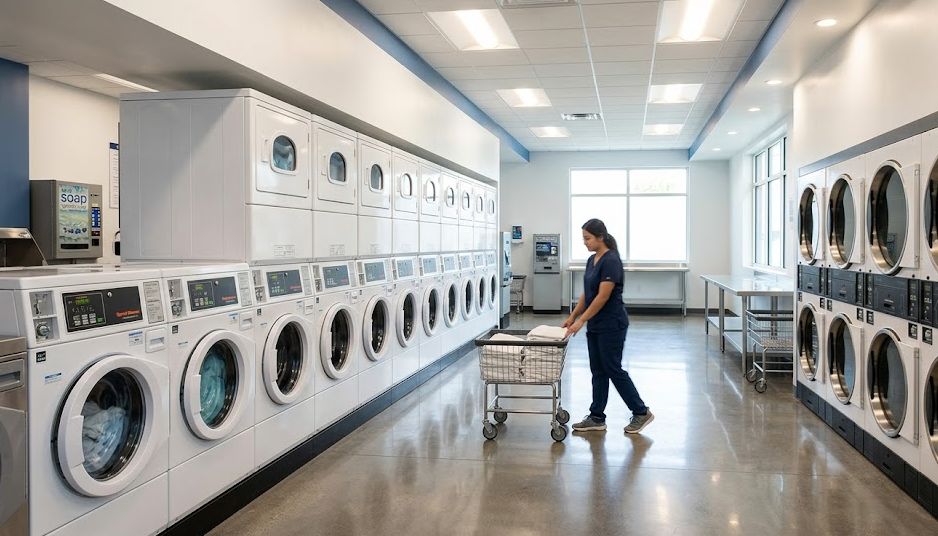
Opening a laundromat in 2026 typically costs between $200,000 and $1,000,000, with most new builds landing in the $300,000 to $750,000 range. The exact total depends on the size of the space, the type and number of machines, the build-out requirements (plumbing, electrical, water heating), the lease or real estate situation, and your local permitting environment.
A small 1,000 to 1,500 square foot laundromat can come in at the lower end of that range. A full-service 3,000 to 5,000 square foot operation with premium equipment and amenities can exceed $1 million.
What Drives the Total Cost
Five major cost categories determine how much capital you need to open a laundromat: equipment, build-out, real estate, working capital, and permits or licensing. Each varies based on the size and ambition of the operation.
Equipment is usually the largest line item. A new commercial-grade washer can cost $1,500 to $15,000, depending on capacity and brand, and a new dryer runs $2,500 to $10,000. A typical mid-sized laundromat installs 25 to 40 washers and 25 to 40 dryers, putting total equipment cost somewhere between $150,000 and $500,000.
Build-out is the second-largest line item. Laundromats require specialized plumbing for hot and cold water lines, drains, and gas lines for water heaters and dryers. Electrical work is substantial because of the high-amp connections required for commercial equipment. Build-out costs typically run $100,000 to $300,000 for a standard 2,000 to 3,000 square foot space.
Real estate costs depend entirely on whether you lease or buy. Most new operators lease. Commercial lease rates for laundromat-suitable retail space vary by market, typically running $15 to $40 per square foot annually in established commercial corridors.
According to IBISWorld, the U.S. laundromat industry generated approximately $7.2 billion in market size in 2026, with a five-year CAGR of about 1.5 percent. The industry remains stable enough to attract new entrants, but startup costs have risen with equipment prices and construction labor.
✓ 6+ months in business
✓ $15,000+ monthly revenue
✓ Active business bank account
Equipment Costs in Detail
Commercial washers come in several capacities and price tiers:
- Small 20-pound washers: $1,500 to $3,500 each
- Medium 30 to 40-pound washers: $3,500 to $7,000 each
- Large 60 to 80-pound washers: $7,000 to $15,000 each
Higher-capacity machines generate more revenue per cycle but cost more upfront. Most laundromats install a mix of sizes to handle different customer needs.
Dryers run similarly:
- 30-pound dryers: $2,500 to $5,000 each
- 50 to 75-pound dryers: $5,000 to $10,000 each
Other equipment includes payment systems (coin or card readers, app integration), change machines, water heaters, ventilation systems, security cameras, and seating. These ancillary items typically add $30,000 to $75,000 to the equipment budget.
If you buy used or refurbished equipment, you can cut equipment costs by 30 to 50 percent, but you take on maintenance risk and a shorter useful life. Used equipment financing has different lender requirements than new equipment financing.
Build-Out and Construction
Laundromat build-out is more involved than most retail because of the utilities required. A typical build-out includes:
- Plumbing for water lines, drains, and gas hookups: $30,000 to $80,000
- Electrical work for 240-volt and high-amp circuits: $25,000 to $60,000
- Water heating systems (commercial water heaters or boilers): $15,000 to $40,000
- HVAC and dryer ventilation: $20,000 to $50,000
- Flooring suitable for water exposure: $10,000 to $25,000
- Lighting, signage, and interior finishes: $15,000 to $40,000
The exact numbers depend on whether the space was previously a laundromat (least expensive) or a clean retail space requiring full build-out (most expensive). Spaces that previously housed laundromats can save $50,000 or more on plumbing and electrical costs because the infrastructure is already in place.
Ready to get started?
Lease, Permits, and Working Capital
Most laundromat operators sign 10 to 20-year leases because the build-out investment is too large to recover on a short lease. Expect to pay first and last months’ rent, a security deposit (often 2 to 6 months of rent), and possibly negotiate a tenant improvement allowance from the landlord that reduces your out-of-pocket build-out costs.
Permitting and licensing costs depend heavily on your local municipality. Standard items include business licensing, plumbing and electrical permits, water and sewer connection fees, and sign permits. Total permit costs typically range from $5,000 to $15,000.
Working capital is the often-overlooked category. Expect to have at least 3 to 6 months of operating expenses available at opening to cover rent, utilities, payroll if you hire attendants, supplies, marketing, and any unexpected issues. Working capital reserves typically run $20,000 to $60,000 for a small laundromat and more for larger operations.
Financing Options That Map to These Costs
A laundromat startup typically uses multiple funding sources matched to each cost category.
For equipment, equipment financing is the natural fit because the equipment itself secures the loan. Lenders typically finance 80 to 100 percent of the new equipment cost, with 10 to 20 percent down. Terms run 5 to 7 years to match equipment useful life.
For build-out, working capital is harder to finance through traditional channels because there’s no physical asset to secure. Many operators use a short-term business loan to cover build-out costs, repaid as the business stabilizes. The SBA 7(a) program can also finance build-out for borrowers who qualify and can wait 30 to 90 days for funding.
For working capital during the first months of operation, a line of credit gives flexible access to funds during the ramp-up period when revenue is still scaling.
Apply for Laundromat Financing with Delta Capital Group
Delta Capital Group is a direct funder, not a broker, providing unsecured working capital from $5,000 to $5,000,000 to business owners across the country. Whether you need equipment financing for new washers and dryers, a short-term loan for build-out costs, or working capital for the first months of operation, our team builds financing packages that match the specific funding stages of a laundromat startup. No collateral beyond the equipment for most equipment financing. Approvals happen in as little as 24 hours, and 95 percent of approved applicants are funded within 48 hours. Minimum qualifications are 6 months in business, $15,000 in monthly revenue, and a 500 credit score.
Need Funds Quickly?
Frequently Asked Questions
Can you open a laundromat for under $100,000?
In most markets, a from-scratch new laundromat costs at least $200,000 to $300,000 because of equipment and build-out requirements. Coming in under $100,000 typically requires buying an existing laundromat with assumable equipment or taking over a closed laundromat space with infrastructure intact.
Is buying an existing laundromat cheaper than building one?
Often yes. Existing laundromats sell for prices that vary widely based on revenue, equipment age, and location, but turnkey purchases typically run $100,000 to $500,000 and avoid most of the build-out cost. The trade-off is that you inherit existing equipment, which may need replacement sooner than new equipment.
How long does it take to break even on a new laundromat?
Industry averages suggest 3 to 7 years to recoup the initial investment, depending on location, pricing, and operational efficiency. Well-located laundromats with strong demographics break even faster. Poorly sited locations may never reach profitability.
What’s the typical monthly revenue for a laundromat?
Monthly revenue varies widely by size and location, ranging from $5,000 for very small underperforming stores to $50,000 or more for high-volume locations. Industry sources suggest mid-range operations generate $15,000 to $30,000 in monthly revenue.
Do laundromats require employees?
Many laundromats run as fully unattended self-service operations with no on-site employees. Larger or full-service laundromats with wash-and-fold services typically hire attendants. Unattended operations save payroll but need more security investment in cameras and secure cash handling.
Can I finance a laundromat with an SBA loan?
Yes, the SBA 7(a) and 504 programs both finance laundromats. The 7(a) program is more flexible, covering equipment, build-out, and working capital. The 504 program covers fixed assets specifically. Both require strong credit, good business plans, and a 30 to 90 day funding timeline.

