
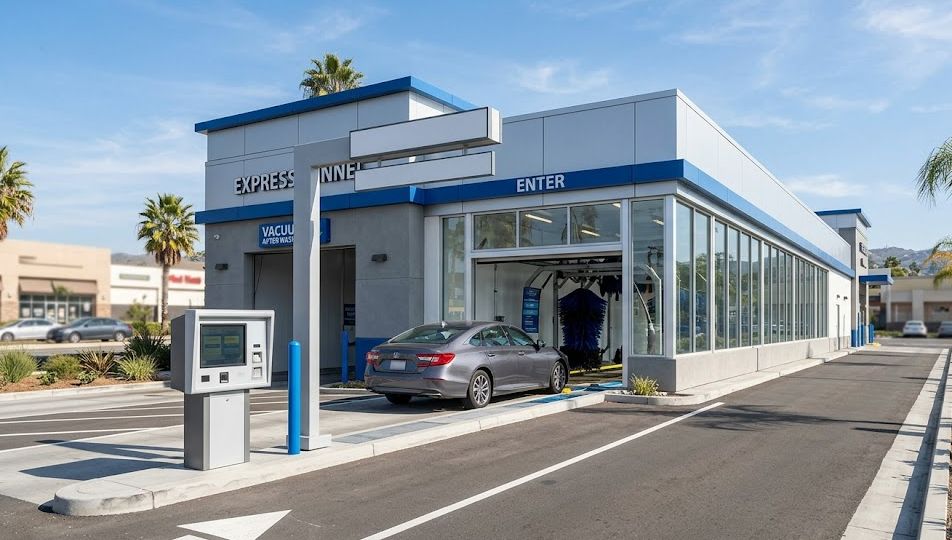
Opening a car wash in 2026 costs anywhere from $100,000 for a small self-serve operation to $5 million or more for a full-service express tunnel. The huge range reflects the wide variety of car wash formats: self-serve bays, in-bay automatics, express exterior tunnels, and full-service tunnels each have very different equipment, real estate, and labor requirements.
Land or lease costs alone can vary from $200,000 to $2 million, depending on location. Equipment ranges from $40,000 for basic self-serve gear to $1.5 million for a fully automated express tunnel. Understanding the cost structure of each format helps narrow down the right starting investment.
The Four Main Car Wash Formats
Car washes break down into four primary business models, each with distinct cost structures.
Self-serve car wash. The customer drives in, pays at a coin or card box, and operates the wand-style sprayer themselves. A typical installation has 4 to 8 bays. Total startup cost ranges from $100,000 to $500,000, with equipment representing the smallest share of the build because the customer does the labor.
In-bay automatic. The customer pulls into a single bay, and the automated system washes the car around them. Equipment is more expensive than self-serve because of the automated washing apparatus. Total startup ranges from $300,000 to $1 million per bay. Most operations install 1 to 3 in-bay automatics.
Express exterior tunnel. The customer pays at an entry kiosk, drives onto a conveyor, and the equipment washes the exterior while the car moves through a 90 to 150-foot tunnel. Very high throughput (60 to 100 cars per hour) and low labor (1 to 3 employees). Total startup ranges from $1.5 million to $5 million.
Full-service tunnel. Combines the conveyor tunnel with interior cleaning, vacuuming, and detailing by employees. Highest labor requirement but also the highest revenue per car. Total startup ranges from $2 million to $5 million or more.
According to IBISWorld, the U.S. car wash and auto detailing industry generated $18.7 billion in market size in 2026, with industry fragmentation making it accessible to new entrants. The format you choose dramatically affects both the upfront investment and the ongoing operations.
✓ 6+ months in business
✓ $15,000+ monthly revenue
✓ Active business bank account
Equipment Costs by Format
Equipment is one of the largest cost categories for any car wash format.
For self-serve bays, equipment runs $20,000 to $50,000 per bay. This covers the spray equipment, payment systems, water reclamation if required, and basic infrastructure.
For in-bay automatics, equipment costs $150,000 to $300,000 per bay. The automated washing system is the bulk of this cost. Touchless systems cost more than friction systems but reduce maintenance.
For express exterior tunnels, equipment runs $500,000 to $1.5 million. The conveyor system, washing arches, drying equipment, water reclamation systems, and pay station kiosks all contribute to the high cost.
For full-service tunnels, equipment costs are similar to express tunnels ($500,000 to $1.5 million) but with additional equipment for interior cleaning stations and vacuum islands.
Beyond the wash equipment itself, every format requires water treatment and reclamation systems (increasingly mandated by local environmental regulations), chemical dispensing systems, and various ancillary equipment like dryers, vacuums, and signage.
Real Estate and Construction
Real estate is often the single largest line item for a car wash, especially express and full-service tunnels.
Express tunnels typically require 0.75 to 1.5 acres of land, with high visibility from major roads. Land costs vary dramatically by market, ranging from $250,000 to $2 million or more for prime locations. Many operators lease the land and build to suit; others purchase the land for long-term equity.
Self-serve and in-bay automatics can fit on smaller parcels (0.25 to 0.5 acres), reducing real estate costs. They can also share parcels with gas stations or convenience stores, which lowers entry cost.
Construction costs add another major layer. A tunnel building costs $300,000 to $700,000 to construct, plus equipment foundations, queuing lanes, drainage, and landscaping. Self-serve bays cost $150,000 to $300,000 to construct.
Permitting for car washes can be more involved than most retail businesses because of water usage, wastewater discharge, and environmental compliance requirements. Expect $10,000 to $50,000 in permit fees and engineering costs, plus longer permit timelines than typical retail (often 6 to 12 months).
Working Capital and Pre-Opening Costs
Beyond construction and equipment, car wash startups need significant working capital reserves. Pre-opening expenses include:
- Marketing for the grand opening and ongoing customer acquisition
- Hiring and training (for express and full-service formats)
- Insurance premiums for liability, property, and business interruption coverage
- Initial chemical and supply inventory
- Working capital reserves to cover the first 6 to 12 months of operating expenses
Typical working capital requirements run $50,000 to $250,000, depending on format. Express tunnels need more reserves because of higher operating overhead.
Financing Options for Car Wash Startups
Most car wash startups use multiple funding sources, matching each cost category to the right financing product.
For the equipment, equipment financing is typically the best fit because the equipment secures the loan. Lenders finance 80 to 100 percent of equipment costs with 10 to 20 percent down. Terms run 5 to 10 years, depending on the equipment’s useful life.
For real estate purchases, the SBA 504 program is a popular option for owner-occupied land and buildings, with long-term fixed-rate financing on major fixed assets.
For build-out and working capital, options vary. Some operators use a short-term business loan to cover construction costs and pre-opening expenses, repaid as the wash stabilizes. A business line of credit provides flexible access to working capital during the ramp-up period.
For total startup financing, SBA 7(a) loans can fund the full project for qualifying borrowers, though the 30 to 90-day timeline is the trade-off.
Need Funds Quickly?
Apply for Car Wash Financing with Delta Capital Group
Delta Capital Group is a direct funder, not a broker, providing unsecured working capital from $5,000 to $5,000,000 to business owners across the country. Whether you need equipment financing for wash systems, a short-term loan for construction overruns, or working capital to bridge the first months of operation, our team builds financing packages that match the specific funding needs of car wash startups. Approvals happen in as little as 24 hours, and 95 percent of approved applicants are funded within 48 hours. Minimum qualifications are 6 months in business, $15,000 in monthly revenue, and a 500 credit score.
Frequently Asked Questions
What’s the cheapest car wash format to start?
Self-serve car washes have the lowest startup cost because the equipment is simpler and the customer does the labor. A 4-bay self-serve operation typically costs $100,000 to $300,000 to build, compared to $1.5 million or more for an express tunnel.
How profitable is a car wash?
Profitability varies by format and location. Express tunnels with strong volume can generate $500,000 to $1.5 million in annual revenue with healthy margins. Self-serve operations typically generate $50,000 to $200,000 annually with lower overhead but a smaller scale.
Do I need to own the land for a car wash?
No, many operators lease the land and build the structure. Leasing preserves capital but builds no equity. Most express tunnel operators choose to own the land to protect their build-out investment.
How long does it take to build a car wash?
From land acquisition to opening, expect 12 to 24 months for an express tunnel, accounting for permitting (6 to 12 months in many jurisdictions), construction (4 to 6 months), and equipment installation and commissioning (2 to 3 months). Self-serve and in-bay automatics are faster, often 6 to 12 months total.
Can I buy an existing car wash instead of building new?
Yes, and many operators do. Existing car wash purchases typically run 3 to 5 times annual cash flow for express tunnels, with the upside of immediate revenue and the downside of inheriting aging equipment. Due diligence on equipment condition, lease terms, and operating history is essential.
What permits do I need to open a car wash?
Permits vary by jurisdiction but typically include a business license, a building permit, water and sewer connection permits, wastewater discharge permit (with environmental compliance review), occupancy permit, and signage permits. Some states or municipalities require additional reclamation system permits or wastewater pretreatment permits.

